The Kazakh president seeks to tighten his grip on power through a new constitution

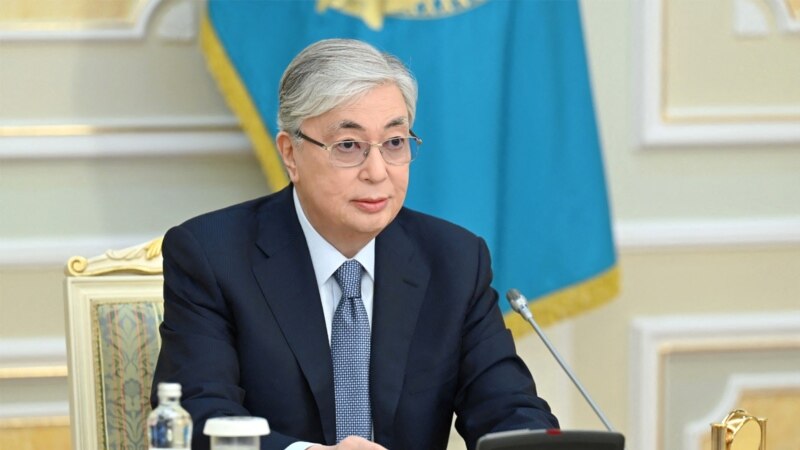
Authorities in Kazakhstan announced that they will hold a referendum next month on a new constitution, in a move seen as a move by President Kassymzomart Tokayev to strengthen his grip on power.
The new basic law also addresses the status of the Russian language, in an attempt to avoid it Provocation of Moscow While meeting the demands of strengthening Kazakh identity after achieving independence in 1991 after centuries of Russian and Soviet domination.
“This is essentially a new constitution,” Tokayev said recently. “Any changes must reflect the will of our citizens.” The referendum is scheduled to be held on March 15.
The authorities have sought to present work on the new draft, submitted on January 31, as comprehensive. Over the course of months, a special committee consulted experts, reviewed more than 10,000 proposals from citizens via online platforms, and held public hearings.
But critics say the process was staged.
Veteran legal expert Maidan Suleimanov said: “What is presented as a national discussion is actually a performance. Participation is symbolic.” “(The draft) constitution reflects the interest of the authority and not the will of the people.”
State repression of critics has reinforced these fears. On February 4, activist Ermek Narimbay was imprisoned for two months over his Facebook posts criticizing the draft. Other activists and journalists have faced police summons, warnings and pressure to delete posts under the “false information” directive.
Redefining power
The project completely restructures the political system in Kazakhstan.
The bicameral parliament is replaced by a unicameral legislature elected through party lists, disenfranchising smaller opposition parties. The new People’s Assembly, fully appointed by the president, has the power to propose legislation.
Moreover, direct presidential authority is expanded. The head of state gains additional influence over appointments and can now appoint a vice president, integrated into executive continuity and succession frameworks.
The project also allows the president to issue decrees that have the force of law in the event of the dissolution of Parliament. Judicial procedures are formalized, but executive control over appointments ensures that the judiciary is not truly independent.
Officials insist the reforms enjoy broad support. Lawmaker Yilnur Besembayev claimed that “Kazakhs support 98% of the rulings.”
Activists question this, noting that the hasty consultation process lacked full social representation and meaningful participation.
Language and identity
Article 9 reaffirms that the Kazakh language is the state language while maintaining the official use of the Russian language in state bodies. On February 10, the Constitutional Committee amended one word: the previous phrase stating that the Russian language is used “on an equal footing” with the Kazakh language was changed to say that it is used “with” the Kazakh language.
The authorities describe this as an editorial adjustment for the sake of consistency between the Kazakh and Russian texts, but some commentators have suggested that it subtly downgraded the status of the implicit Russian language.
Many citizens see this as the most controversial part of the draft – a symbolic battleground over identity, sovereignty, and the post-Soviet legacy. Activists argue that even minor changes in wording reflect larger questions about the cultural and political weight of Kazakh versus Russian, which remain widespread in cities, state institutions, and daily life.
Some activists believe that the status of Kazakhs is still not adequately protected.
“The ambiguous language prevents the full use of the Kazakh language in public life,” said civil activist Serek Alioli. “Citizens must defend their right to access services in the state language. Removing or clarifying the ‘official language’ standard for the Russian language is a demand of our time.”
Political scientist Dos Cochem and lawyer Merman Kalmakhanuli said the wording fueled perceptions that Russians and Kazakhs were equal in public life, undermining efforts to promote Kazakhstan in official spheres. Activist Zharkin Korentaev was arrested before holding a press conference on the topic, illustrating the dangers to public discussion of the constitution.
Supporters of retaining the Russian language believe that this measure is practical, maintains social cohesion and avoids tension with Russia, which has historically used the pretext of protecting Russian speakers abroad.
Moscow has cited Ukrainian legislation making the use of the Ukrainian language mandatory in many areas of public life as evidence of false allegations of “genocide” against Russian speakers in the country – and a pretext for war.
One Kazakh lawmaker, Ermurat Babi, stressed the need to be careful on the issue of language.
“It is wiser for the majority to embrace their language with careful respect rather than turning it into a weapon of conflict,” he said.
Ethnic Russians make up about 15% of the population of Kazakhstan.
The authorities also seem to realize that changing Russia’s constitutional status could inflame internal tensions and provoke Moscow. The intensity of the debate highlights how language in Kazakhstan remains an integral part of identity, politics and geopolitics.